Why Is Custom Framing So Expensive?
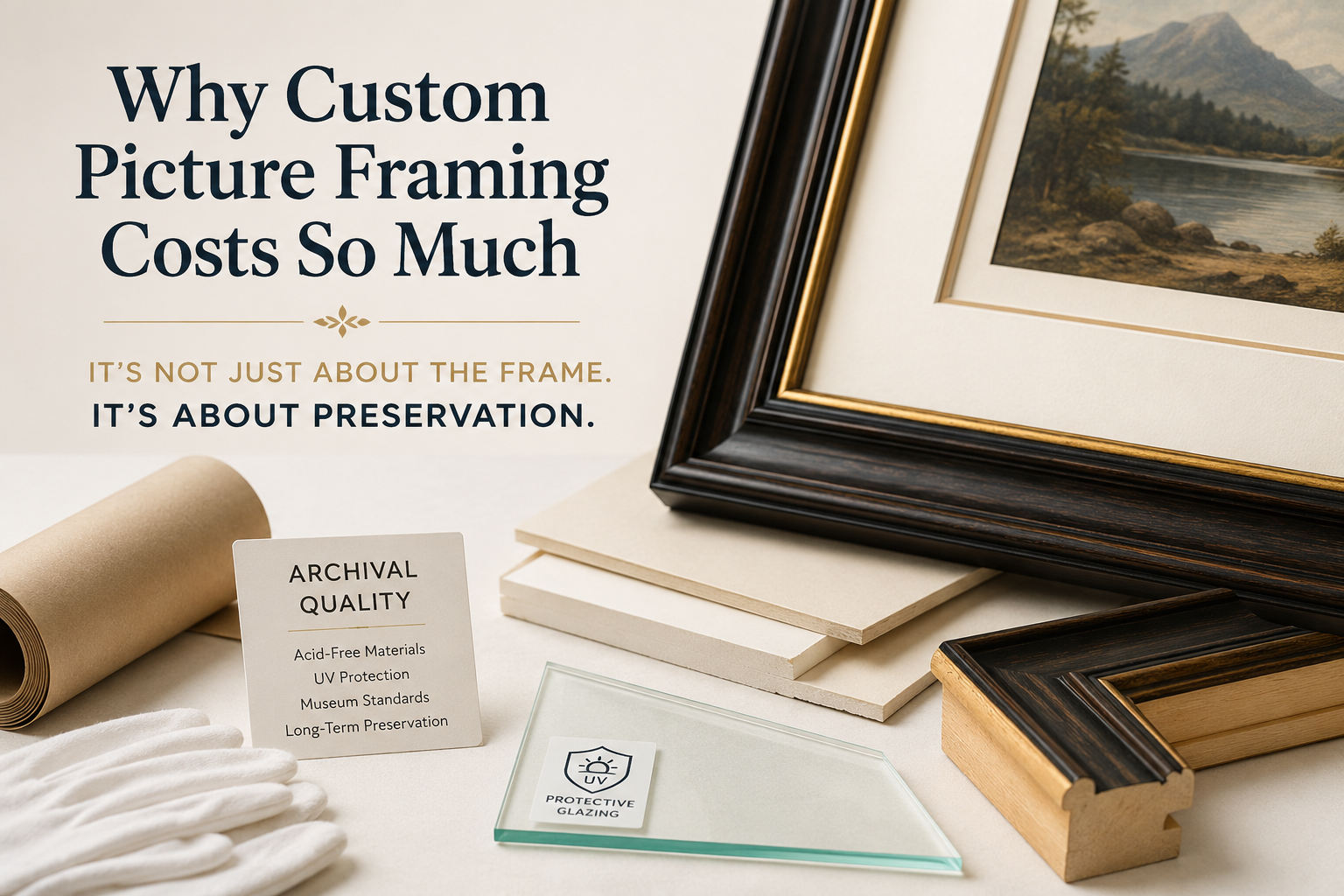
You bring in a piece you love, a watercolor from a local artist, a photograph from your daughter's wedding, a vintage print you've been meaning to frame for years, and the quote comes back and stops you cold. That much? For a frame?
It's a fair reaction. And as a custom framer, I'd rather give you a real answer than a defensive one.
So here it is: most of what you're paying for isn't the frame. It's preservation.
The Frame Is the Last Line of Defense
Artwork is fragile in ways that aren't always obvious. Light fades color. Humidity causes paper to warp and degrade. Acids, which are present in cheap matboard, cardboard, and wood, will migrate into paper and photographs over time. These acids cause yellowing, brittleness, and permanent staining. Dust and insects can do damage you won't see until it's too late.
A well-made frame isn't just a decorative border. It's a sealed, protective environment and a controlled system designed to isolate your artwork from everything that would degrade it. When we talk about preservation framing, we mean framing that is built from the inside out with that goal in mind.
That costs more than a frame from a big-box store. It costs more because the materials are better, the standards are higher, and someone who knows what they're doing is making decisions on behalf of your artwork.
What Preservation Framing Actually Includes
A preservation frame job is a system with several components, each playing a specific protective role:
Archival matboard creates a physical barrier between your artwork and the glazing. This type of matboard is acid-free and lignin-free, so it won't off-gas the acids that damage paper over time. Cheap matboard does. You won't see the difference on day one. You'll see it in ten years.
Conservation glazing utilizes UV-filtering glass or acrylic which blocks the wavelengths of light responsible for fading. Sunlight is the obvious threat, but fluorescent and LED lighting cause fading too, just more slowly. UV glazing is not an upgrade. For anything you care about, it's the baseline.
Archival backing seals the back of the frame against dust, insects, and humidity fluctuations. It also provides structural support that keeps the artwork from shifting or sagging inside the frame.
Proper mounting uses reversible, archival materials like Japanese tissue hinges or acid-free corners that hold the artwork in place without adhesives that yellow, off-gas, or make future conservation impossible. If a conservator ever needs to work on your piece, reversibility matters.
Together, these materials add cost. They're more expensive than their non-archival equivalents because they're manufactured to standards that basic materials don't meet. But they're what the "preservation" in preservation framing actually means.
Custom Means Custom
Beyond the materials, the work itself is done to your artwork's specific dimensions, not a standard size it's been forced to fit. Every mat is cut to your specifications. Every frame is cut and joined by hand. Every element of the frame is fitted and assembled with your particular piece in mind.
The Regret Usually Goes One Direction
In many years of framing, I've never had a customer come back and say they wished they'd spent less on preservation. The regrets run the other way such as the person who chose basic glass and is watching a beloved print slowly fade, or the one who found, years later, that the brown stain spreading through their matboard came from an acidic backing that was slowly destroying the paper behind it.
Preservation framing is more expensive upfront. It is almost always cheaper than the alternative over time and not just in dollars, but in what you don't lose.
The Honest Bottom Line
Custom framing is expensive because preservation is expensive. Good archival materials cost more and skilled labor takes time. Building a frame that will actually protect what you love for decades, not years, isn't something you can shortcut without consequences.
What you're really paying for is the confidence that the piece you're bringing in today will look the same twenty years from now.
If you have something you've been putting off because you're not sure it's "worth" framing, bring it in. We'll look at it together, talk through what level of preservation makes sense, and find an approach that works, for the art and for your budget.
Workshop & Gallery at 216 offers custom preservation framing on Little Deer Isle, Maine. Contact us to discuss your project.